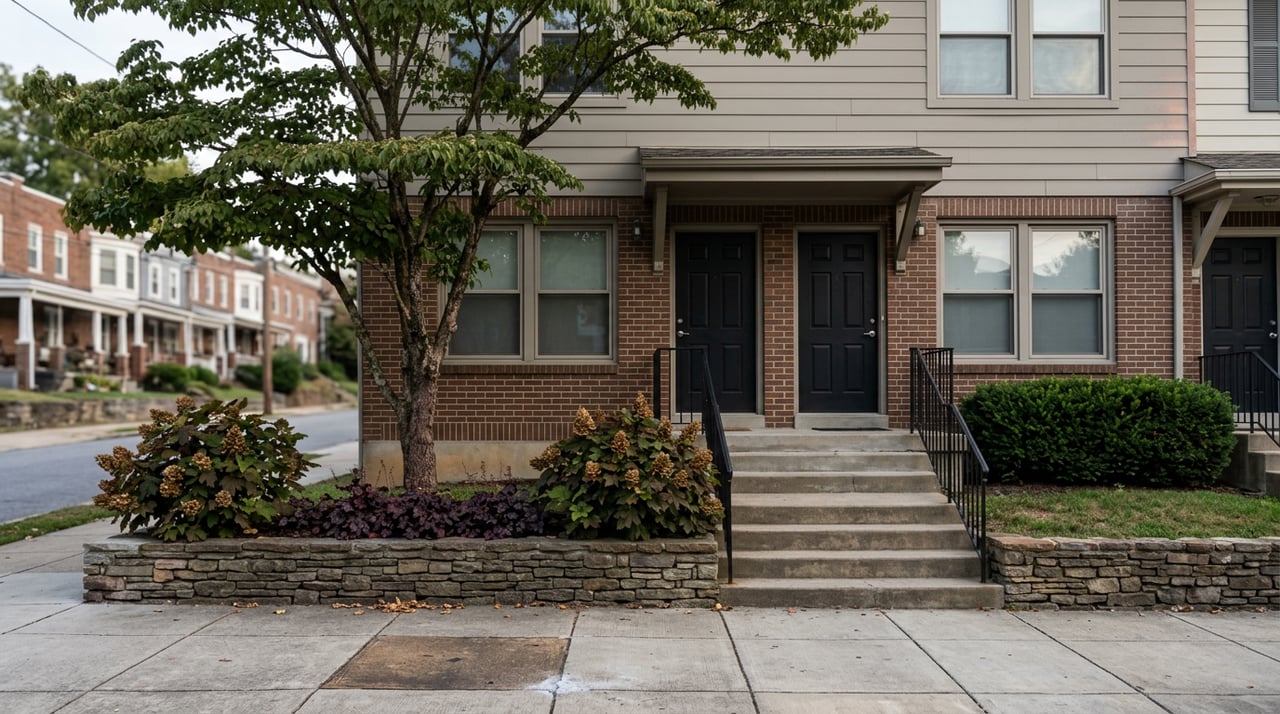
North Bergen vs. Hoboken: What the Price Gap Actually Buys
A buyer touring North Bergen this summer will hear some version of the same pitch: same light rail line as Hoboken, same ferry terminal fifteen minutes away, same skyline view from the right block, at a fraction of the price. It's a fair pitch. It's also an incomplete one.
The interesting part isn't the price gap. It's what happens to that gap once you follow it past the listing price and into the tax bill, the property type, and a transit promise that's been "almost here" since 2001.
As of August 1, 2026, Hudson County's active listings carried a median list price of $699,000. North Bergen has been running well under that mark, with spring 2026 data putting its median sale price around $537,500 and its average closer to $550,000. Hoboken, meanwhile, has recently sold at a median near $872,100. On paper, a buyer moving from Hoboken's price point to North Bergen's is pocketing something like a 35 to 40 percent discount on the purchase price.
Here's where it gets less tidy. Property tax estimates for Hoboken vary a fair amount depending on the source and the valuation methodology behind it, with effective rates cited anywhere from about 1.1 percent to just over 2 percent, and annual bills landing somewhere between roughly $7,600 and just under $10,000 on a comparable home. North Bergen's own effective rate runs close to 1.6 percent, with a typical annual bill in the neighborhood of $8,000.
Put those two ranges side by side and the spread narrows considerably:
The discount you thought you were getting on price is partly a discount, and partly a bet on which tax estimate turns out to be closer to your actual bill. Neither city's number should be treated as gospel. New Jersey's Division of Taxation publishes the general and effective tax rate methodology by municipality, and it's worth five minutes before you assume either figure holds.
A 35 percent discount on the sale price and a nearly identical tax bill is not the same story as a 35 percent discount on the true cost of ownership.
Part of why the comparison gets muddy is that North Bergen and Hoboken aren't really selling the same product at two prices. They're selling two different products.
Hoboken and the Jersey City waterfront are dominated by condos and restored brownstones built for a single household. North Bergen's market leans heavily on two- and three-family homes, particularly west of Kennedy Boulevard where quieter, tree-lined blocks give way to detached and semi-detached housing stock built for multiple units under one roof. Recent listings have included legal three-family properties with separate utilities and established rent rolls, and at least one builder, Silverline, has a new-construction three-family currently slated for delivery in fall 2026, aimed squarely at buyers who want modern systems without inheriting someone else's deferred maintenance.
That distinction matters more than it sounds. A buyer comparing a Hoboken one-bedroom condo to a North Bergen two-family isn't comparing apples to apples on a price-per-square-foot basis. They're comparing a lifestyle purchase to an income-producing asset. The North Bergen property often carries a second unit that can offset the mortgage, which is precisely why the market has stayed active among investors and owner-occupants who plan to house hack rather than occupy the whole structure. Multi-family listings in North Bergen have recently carried a median asking price near $975,000, a figure that only makes sense once you remember it's pricing a building with two or three rentable units, not a single condo.
For the move-up buyer who wants one unit and one mortgage, that's a reason to look closely at what's actually for sale before assuming North Bergen is simply Hoboken at a discount. For the investor evaluating cash flow, it's the opposite: North Bergen's stock is arguably the more legible investment product of the two markets, because Hoboken and downtown Jersey City have far fewer two-to-four family buildings changing hands at all.
The Hudson-Bergen Light Rail's Tonnelle Avenue station is North Bergen's biggest transit asset, and it has been since NJ Transit opened it as the system's northern terminus. At its grand opening, NJ Transit described the ride from Tonnelle Avenue to the Port Imperial ferry connection at about four minutes, with a trip to Hoboken Terminal running around sixteen. That's the geography doing the heavy lifting in every "North Bergen is basically Hoboken" pitch, and it's accurate as far as it goes.
What doesn't get mentioned as often is the Northern Branch Corridor Project, the long-proposed extension of the light rail north from Tonnelle Avenue into Bergen County, first studied back in 2001. The project has been redesigned, rescoped, and delayed multiple times since. In 2023, the Federal Transit Administration rescinded its notice of intent on the existing environmental review, citing changes in flood plain and stormwater conditions since the original study. NJ Transit didn't formally restart that process until November 14, 2025, when it issued a request for proposals to hire a consultant for a new environmental impact statement. State Senator Paul Sarlo and Assemblyman Clinton Calabrese have both spoken publicly in support of finishing the project, and Bergen County Executive James Tedesco has framed it as overdue mass transit for one of the state's most densely populated counties.
The extension, if it's ever built, would add seven new stations across North Bergen, Ridgefield, Palisades Park, Leonia, and Englewood, running along West Side Avenue in North Bergen before transitioning onto an existing CSX freight right-of-way further north. So yes, a new in-town stop is part of the plan on paper. What's also part of the record is that this exact plan, or some close variant of it, has been on paper since 2001.
That's a useful piece of context for anyone pricing in future transit as part of North Bergen's investment case. This project has been redrawn and delayed for close to a quarter century and, as of this writing, is back at the environmental review stage with no construction date attached to it. It may be a legitimate long-term tailwind for the corridor. It is not a near-term catalyst, and a buyer paying a premium today on the assumption that a new station is imminent is pricing in a timeline that has never once held.
If you're weighing North Bergen against Hoboken or the Jersey City waterfront, the more useful comparison isn't sale price to sale price. It's total carrying cost to total carrying cost, and asset type to asset type.
Before you anchor on a discount, pull the last two years of actual tax bills on any specific property you're serious about, not just a municipal average. Ask whether you're comparing a condo to a condo or a condo to a building with rentable units, because those are different investments with different math. And treat any transit-driven upside as a long-horizon possibility rather than something priced to arrive on a predictable schedule.
None of this makes North Bergen a lesser option. It makes it a different one, and the difference is exactly what a buyer needs to understand before writing an offer instead of after.
Is North Bergen's lower price simply because it's further from Manhattan? Not meaningfully. Tonnelle Avenue sits on the same Hudson-Bergen Light Rail line that runs through Hoboken and connects to the Port Imperial ferry, so the transit access is largely shared. The price difference has more to do with housing stock composition and market positioning than distance.
Will the light rail extension raise North Bergen home values? It's too early to say with confidence. The project, which would add a new station within North Bergen along with stops in four Bergen County towns, is currently back at the environmental review stage after a 2025 restart, with no construction timeline announced. A plan first proposed in 2001 that still hasn't broken ground is not something to price in on a near-term basis.
Are property taxes really that close between the two markets? Estimates vary by source and methodology, which is exactly why a specific address's actual tax history matters more than a citywide average. Ranges for both markets can overlap more than the sale price gap suggests, so this is worth verifying property by property rather than assuming a fixed rule.
If you're trying to figure out what a specific budget actually buys along this corridor, whether that's a single-family home, a two-family with rental upside, or something closer to Hoboken's condo stock, Alena Ciccarelli Properties can walk through the real numbers on a property-by-property basis. Arrange a Viewing to see how the math works on the ground, not just on a spreadsheet.
Explore my latest insights, market trends, tips, and updates on real estate.

Whether you’re buying or selling, Alena Ciccarelli delivers exceptional service, local expertise, and a client-first approach that makes your real estate journey seamless and rewarding. If you want to get the highest value for your home, contact Alena for a free consultation!
Alena Ciccarelli
1412 Washington St Hoboken, NJ, 07030